
AEO vs GEO vs SEO: Key Differences and What Your Business Needs in 2026
Quick Answer
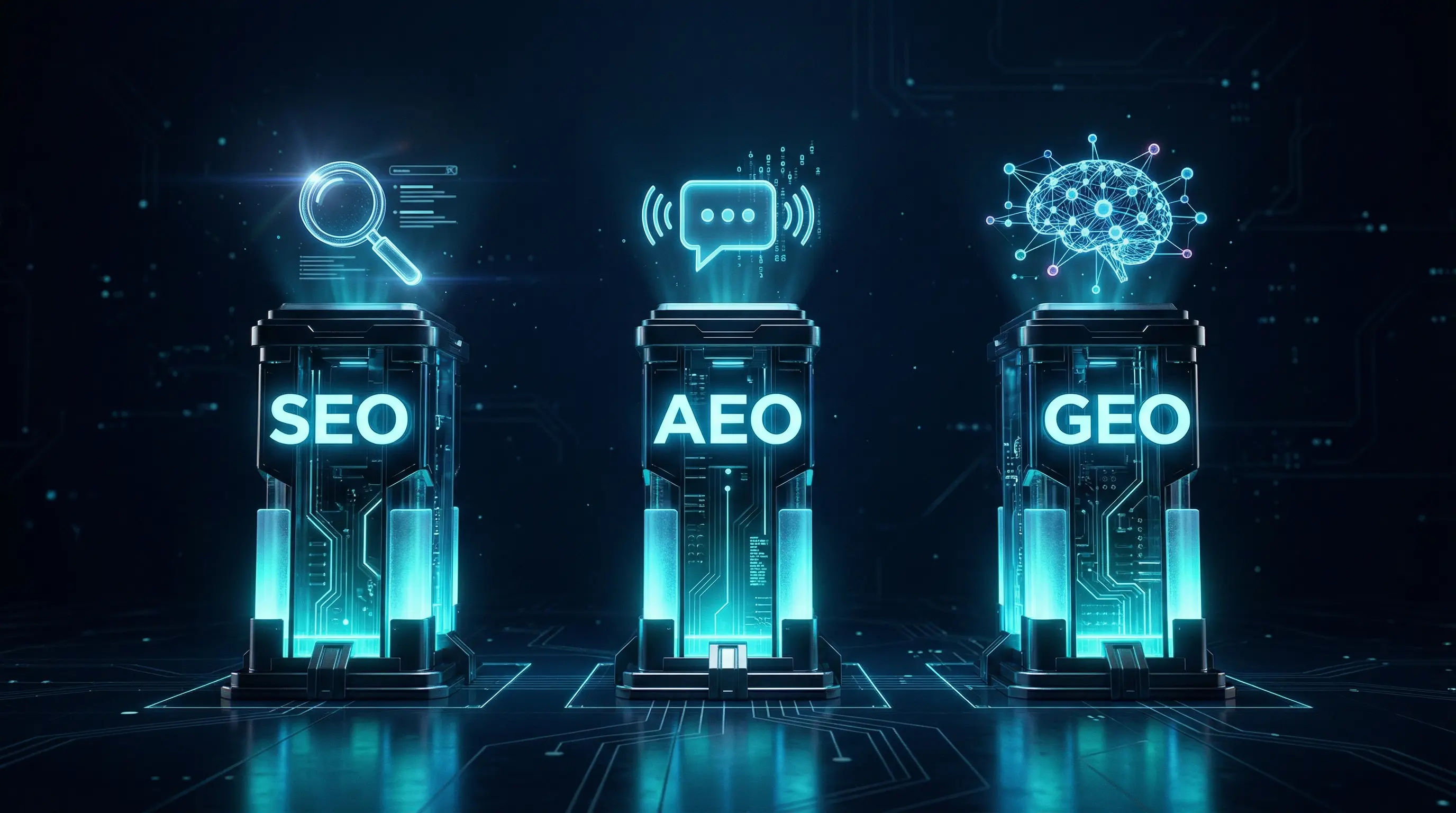
SEO (Search Engine Optimisation) targets Google's traditional blue-link results. AEO (Answer Engine Optimisation) gets your site cited in AI-generated answers during live searches on Perplexity, ChatGPT, and Google AI Overviews. GEO (Generative Engine Optimisation) shapes how AI models describe your brand from their core training data - even without a web search. In 2026, all three matter. Most Indian businesses have only SEO. The biggest opportunity lies in AEO and GEO.
The Changing Search Landscape
In 2023, "search" meant Google. In 2026, search is fragmented:
- Google still dominates traditional search with 8.5 billion daily queries
- Google AI Overviews now appear on over 1 billion monthly searches in India alone
- ChatGPT with browsing processes millions of product and service queries daily
- Perplexity AI is growing at 10x year-over-year with 100M+ monthly active users
- Gemini is integrated into Android and Google Workspace, reaching 2+ billion devices
Each of these platforms uses a different mechanism to find and present information - which is why one optimisation strategy no longer covers all of them.
SEO: What It Is and Why It Still Matters
How SEO Works
Traditional SEO signals to Google's crawlers that your pages are relevant, authoritative, and technically sound. Google's algorithm evaluates 200+ ranking signals to decide which pages to show for any given query.
Key SEO activities:
- Keyword research and on-page optimisation
- Technical site health (Core Web Vitals, mobile usability, indexability)
- Backlink building from authoritative domains
- Content quality and E-E-A-T signals
- Local SEO for location-based queries
Who Needs SEO
Every business with a website. SEO is the foundation. Without it, your site may not be indexable by AI search engines either, since most AI search tools rely on web indexes.
SEO Limitations in 2026
- Google is adding AI features that reduce click-through rates for informational queries
- Zero-click searches (where AI Overviews answer the question directly) are rising
- Traditional blue-link ranking is becoming less visible on mobile
Bottom line: SEO is necessary but no longer sufficient.
AEO: What It Is and How It Works
How AEO Works
AEO structures your content so AI systems can extract it and cite it in generated answers. When a user asks Perplexity "what are the best [services] in Ahmedabad?", Perplexity's AI reads multiple sources and synthesises an answer - citing the sources it found most authoritative.
Key AEO activities:
- FAQPage schema markup on every page
- Quick Answer Boxes (direct-answer paragraphs at the top of pages)
- llms.txt file at domain root
- Entity citations on Clutch, GoodFirms, Crunchbase
- robots.txt allowing all AI crawlers
- Conversational, question-format content
Where AEO Gets You Cited
- Google AI Overviews - appear above organic results for billions of queries
- Perplexity AI - cited in real-time synthesised answers
- ChatGPT (with browsing) - cited when browsing mode is active
- Bing Copilot - integrated AI assistant across Microsoft products
Who Needs AEO
Any business that wants to be visible in the AI-augmented search results that are now appearing at the top of Google and Perplexity. Particularly valuable for service businesses, consultants, healthcare providers, and e-commerce.
See our AEO services for how we implement this for Indian businesses.
GEO: What It Is and How It Works
How GEO Works
Generative Engine Optimisation (GEO) targets the base knowledge of AI language models - the information they learned during training, before they perform any live web search. When someone asks ChatGPT "tell me about [your company]", the model draws on what it learned during training - which happened months or years ago.
GEO builds your brand's presence in the data that feeds those training cycles: Wikipedia, authoritative publications, knowledge graphs, structured brand data, and consistent entity signals.
Key GEO activities:
- Brand entity building (Google Knowledge Panel, Wikidata, structured data)
- Digital PR on authoritative publications
- Consistent brand narrative across all web properties
- llms.txt and AI documentation strategy
- AI output monitoring (tracking how models describe your brand)
- Competitive GEO analysis
Where GEO Gets You Visible
- ChatGPT base knowledge - how the model describes your brand without browsing
- Google Gemini - brand descriptions in conversational queries
- Claude (Anthropic) - brand accuracy in trained responses
- Meta AI - brand presence in WhatsApp and Instagram AI features
- Any future AI model trained on authoritative web data
Who Needs GEO
Brands with national or international ambitions. B2B businesses where clients research vendors using AI. Any business category where brand reputation and authority matter.
Side-by-Side Comparison
| Factor | SEO | AEO | GEO |
|---|---|---|---|
| Target platform | Google search | AI-augmented search | AI base model knowledge |
| Mechanism | Crawling & ranking | Real-time AI synthesis | Training data & knowledge graphs |
| Primary signal | Backlinks & content | Schema + FAQs + entity signals | Authority citations + knowledge graphs |
| Time to results | 3–12 months | 4–12 weeks | 6–18 months |
| Measurability | Google Search Console | AI answer tracking | AI query monitoring |
| Cost (VGraple) | From ₹8,000/mo | From ₹12,000/mo | From ₹25,000/mo |
| Competitors doing it | Most | Few | Almost none |
| First-mover advantage | Low (saturated) | Medium | High |
The AI Search Triple Play: All Three Together
The most effective strategy for 2026 is not choosing one - it is sequencing all three:
Phase 1 - Foundation (Month 1–3)
- SEO technical audit and fixes
- AEO implementation: FAQPage schema, llms.txt, Quick Answer Boxes
- AEO entity signals: Clutch, GoodFirms, directory citations
Phase 2 - AI Visibility (Month 3–6)
- First AI Overview citations start appearing
- Perplexity citations tracked and optimised
- GEO foundation: Knowledge Panel, Wikidata, brand documentation
Phase 3 - Brand Authority (Month 6–18)
- Digital PR campaign for GEO authority citations
- AI output monitoring and brand narrative refinement
- Competitive GEO gap analysis and exploitation
What to Prioritise for Indian SMEs
If budget is limited, prioritise in this order:
- SEO - without Google visibility, you have no traffic foundation
- AEO - the incremental cost is low (mostly content restructuring + schema)
- GEO - invest once SEO and AEO are generating results
For businesses with international clients or B2B enterprise clients, GEO should be accelerated - high-value clients are the most likely to use ChatGPT and Gemini for vendor research.
Conclusion
The search landscape of 2026 requires a three-channel strategy. SEO keeps you visible on Google. AEO gets you cited when AI answers live queries. GEO ensures AI models describe your brand as an authority - even in future AI products not yet launched. Businesses that act on all three today will be unreachable by competitors who wait.
Contact VGraple for an AI search strategy audit covering SEO, AEO, and GEO. We'll tell you exactly where you stand across all three - and what to fix first.
Written by
VGraple Digital Team
The VGraple team has 14+ years of experience in web design, SEO, AEO, and digital marketing. Based in Ahmedabad, we serve 700+ businesses across India, UK, US, and Australia.
Need Expert Help?
VGraple has helped 700+ businesses grow online since 2011. Get a free consultation from our specialists.
Get Free Quote